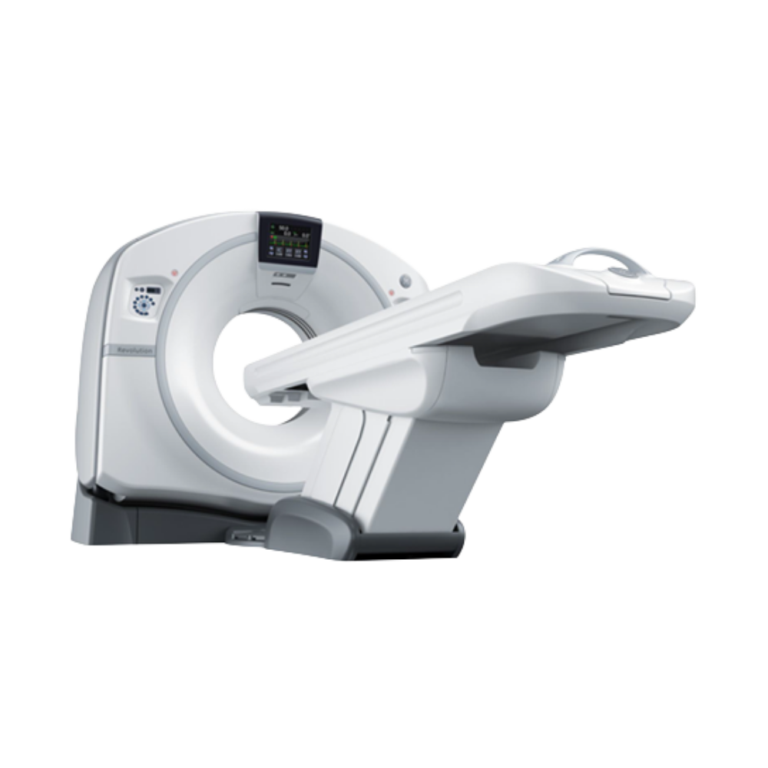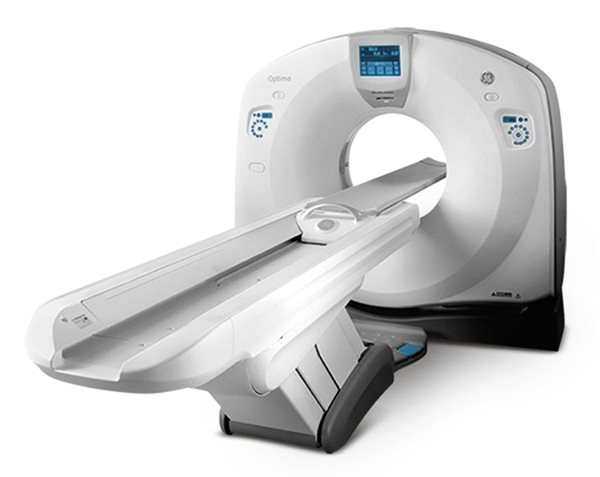
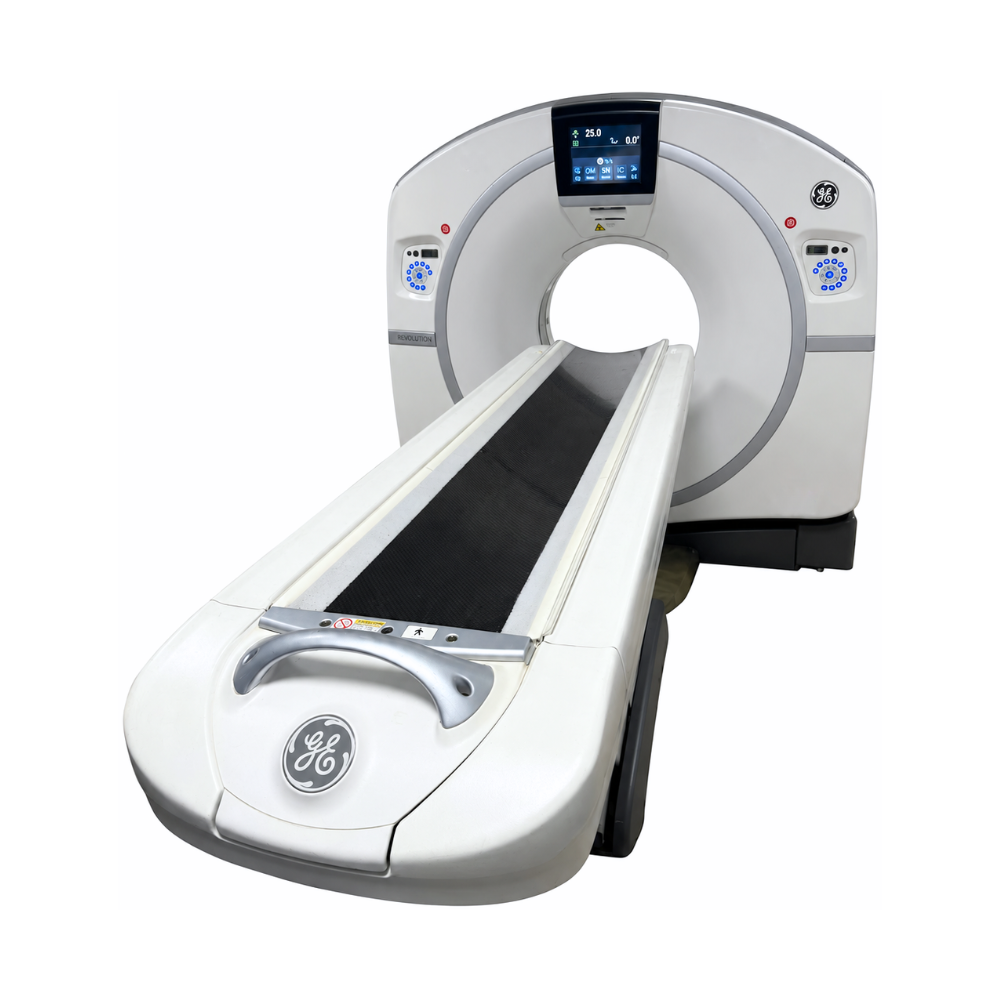
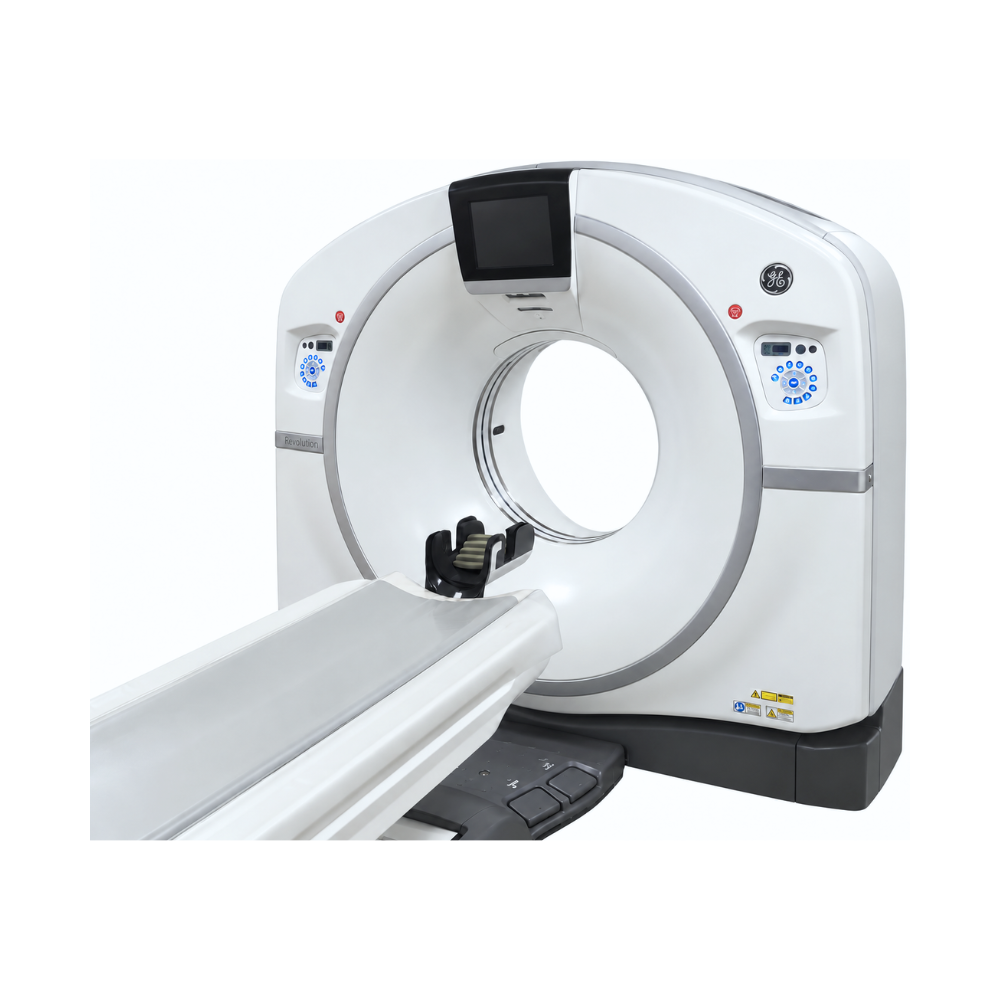
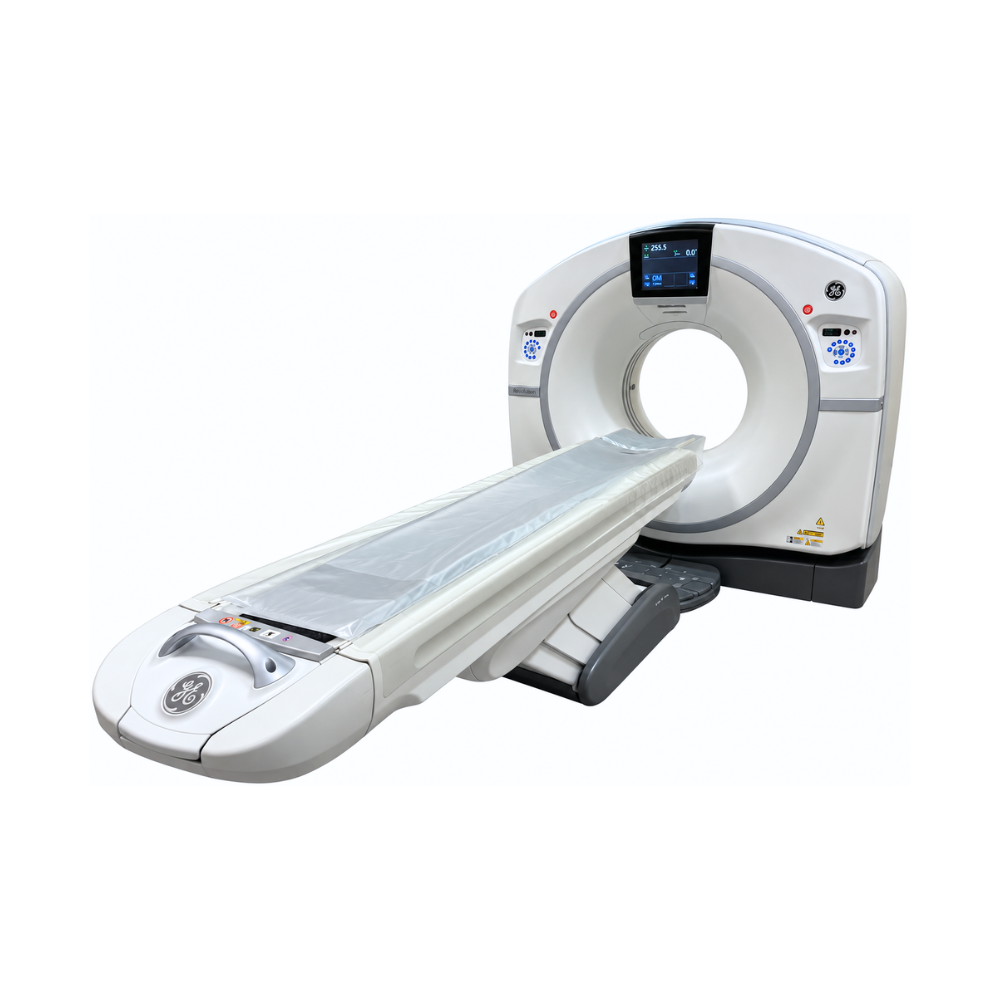
GE Revolution EVO 128-Slice CT
- Category:
- CT Scanners
- Brand:
- GE
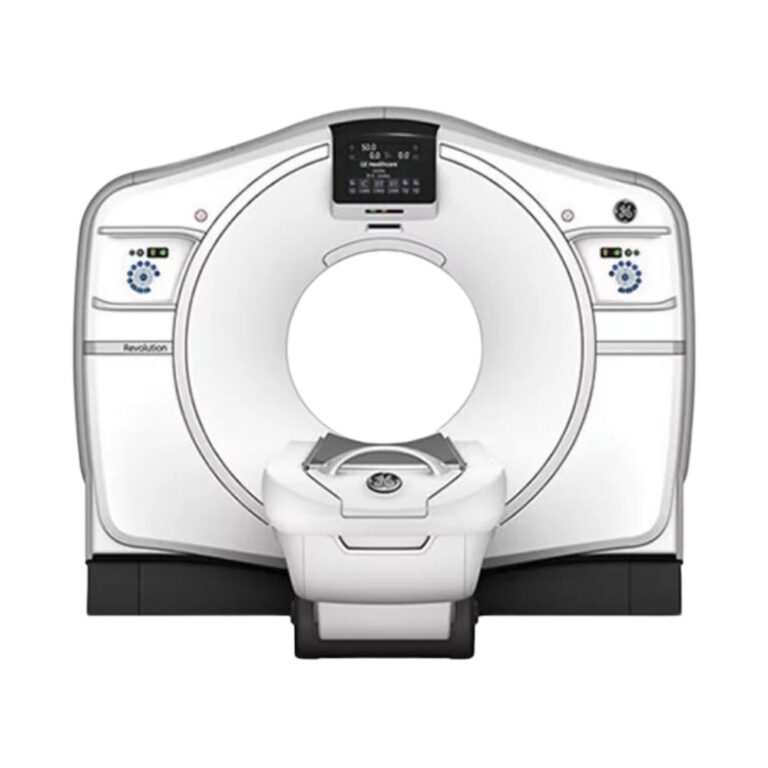
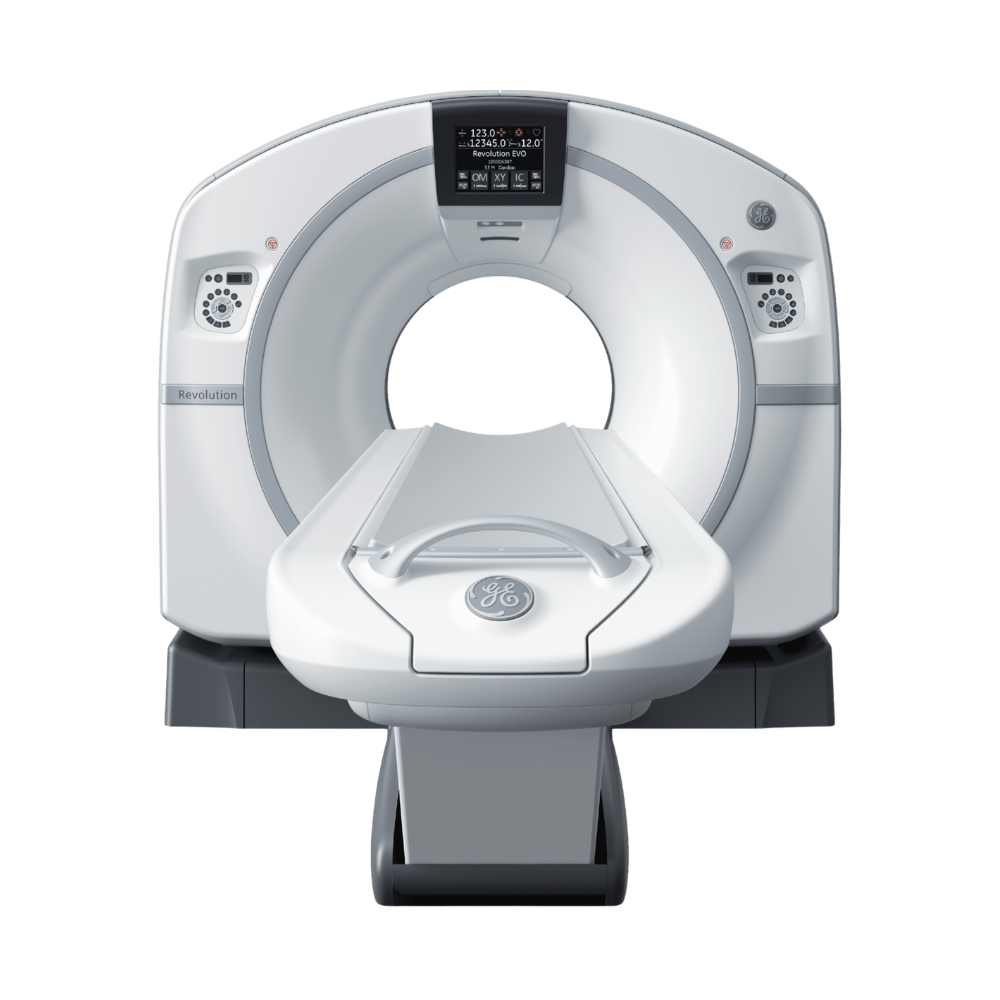
The GE Revolution EVO 128 is a 128-slice CT scanner well suited for hospitals, imaging centers, and specialty practices seeking detailed anatomical reconstruction. Its Clarity detector and overlapping reconstruction support up to 128 image sections per rotation in compatible modes, while available ASiR-V technology, cardiac applications, and workflow options support advanced examinations.
Revolution EVO 128 CT Highlights & Benefits
The GE Revolution EVO 128 combines 64-channel acquisition with advanced 128-slice reconstruction for detailed image review across routine and specialized CT examinations. Its Clarity Imaging Chain supports fine anatomical detail, while configurable clinical software and workflow technologies help facilities match system capabilities to their imaging requirements.
Key Features & Benefits
-
- 128-Slice Reconstruction: Produces up to 128 overlapping image sections from 64-channel acquisition in compatible modes, supporting detailed anatomical review.
- 40 mm Clarity Detector: Captures thin-slice imaging data across 40 mm (1.57 in) of detector coverage per rotation.
- High-Resolution Imaging: Provides spatial resolution as fine as 0.28 mm (0.011 in) for evaluating small anatomical structures.
- 0.35-Second Gantry Rotation: Available on compatible configurations to support rapid scanning and reduce motion-related artifacts.
- ASiR-V Reconstruction: Available advanced processing that reduces image noise while supporting patient-specific radiation-dose management.
- Advanced Cardiac & Vascular Imaging: Compatible applications support coronary imaging, CT angiography, and specialized vessel analysis.
- Configurable Reconstruction & Workflow Upgrades: Available console and software options support efficient image processing and advanced clinical applications.
Revolution EVO 128-Slice Reconstruction & Image Quality
The GE Revolution EVO 128 combines GE’s Clarity Imaging Chain with overlapping reconstruction to support detailed CT interpretation. Its 128-slice capability provides closely spaced reconstructed images from 64-channel acquisition without requiring 128 physical detector rows.
128-Slice Reconstruction from 64-Channel Acquisition
The Revolution EVO 128 acquires data through 64 detector channels covering 40 mm (1.57 in) of anatomy per rotation. GE’s conjugate cone-beam back-projection technology uses complementary X-ray measurements to improve image detail along the length of the patient.
Compatible axial acquisition and overlapping reconstruction can generate up to 128 image sections per rotation. These closely spaced reconstructions support detailed review of small vessels, fine bone structures, and other anatomy in coronal, sagittal, and three-dimensional views.
The 128-slice designation describes reconstruction capability rather than twice the physical detector coverage. Available reconstruction output varies by acquisition mode and settings, making the scanner’s installed capabilities an important part of system selection.
Clarity Imaging Chain for Fine Anatomical Detail
GE’s Clarity Imaging Chain combines the detector, data acquisition system, X-ray tube, and reconstruction technologies to manage image noise, resolution, and artifacts.
Its components include:
-
- Clarity Detector: Captures thin-slice measurements across 40 mm (1.57 in) of anatomical coverage, with acquired slice thickness down to 0.625 mm (0.025 in).
- Clarity Data Acquisition System: Processes detector measurements using technology designed to reduce electronic noise and support consistent reconstruction.
- Performix 40 Plus X-Ray Tube: Provides X-ray output and heat-management capabilities for routine and advanced examinations.
- ASiR-V Reconstruction: Available advanced processing that reduces image noise while preserving diagnostically useful anatomical detail.
Together, these technologies support spatial resolution as fine as 0.28 mm (0.011 in), useful for vascular, musculoskeletal, and other examinations requiring detailed anatomical evaluation.
0.35-Second Rotation & High-Pitch Scanning
Compatible Revolution EVO configurations complete a gantry rotation in as little as 0.35 seconds, helping limit motion-related image distortion during cardiac, vascular, and time-sensitive examinations.
Available high-pitch helical scanning, with pitch values up to 1.531, advances the patient table farther during each rotation to cover longer anatomical regions more quickly. This can reduce acquisition time and breath-hold requirements during selected examinations.
Rotation speed and high-pitch capabilities depend on the installed configuration.
Revolution EVO 128 Reconstruction & Dose Management
The Revolution EVO supports technologies designed to balance anatomical detail with patient-specific radiation-dose management. Available reconstruction software reduces image noise, while exposure controls help technologists tailor scanning parameters to the patient and examination.
ASiR-V for Image Clarity & Dose Optimization
Revolution EVO configurations may include different generations of iterative reconstruction technology, which uses computational processing to reduce image noise while preserving diagnostic detail.
-
- ASiR: Adaptive Statistical Iterative Reconstruction reduces image noise and supports diagnostic image quality at appropriately selected radiation-dose settings.
- ASiR-V: Advanced reconstruction that incorporates additional image and physics modeling to improve low-contrast visibility and noise reduction. Under specified comparative testing conditions, ASiR-V demonstrated radiation-dose reductions of up to 82% compared with conventional filtered back projection at equivalent image quality.
- TrueFidelity: Deep-learning image reconstruction available on certain eligible later-generation or upgraded configurations. It uses trained reconstruction methods to reduce noise while preserving anatomical appearance.
ASiR-V and TrueFidelity require compatible hardware, software, and licenses. Actual image-quality and dose benefits vary with patient anatomy and clinical protocols.
Patient-Specific Exposure & Dose Monitoring
Compatible Revolution EVO configurations provide automated controls to help manage radiation exposure during scanning.
-
- AutomA & SmartmA: Adjust X-ray tube current according to patient anatomy and body thickness, supporting consistent imaging across different anatomical regions.
- Organ Dose Modulation: Adjusts exposure during selected examinations to help manage radiation reaching sensitive anatomical structures.
- Dose Check: Provides configurable alerts and notifications when planned radiation-dose parameters reach established thresholds.
- Dose Reporting: Records examination dose information for compatible institutional monitoring and quality-assurance workflows.
These technologies complement iterative reconstruction by managing exposure during image acquisition.
Smart MAR & Image Artifact Reduction
The Revolution EVO offers available processing technologies that address image distortion caused by metal implants, dense anatomy, and certain scanning conditions.
-
- Smart Metal Artifact Reduction (Smart MAR): Reduces streaks and distortions caused by metallic implants, improving visibility around joint replacements and surgical hardware.
- Advanced Artifact Reduction (AAR): Helps reduce certain streak artifacts associated with highly attenuating anatomy.
- IQ Enhance: Reduces certain helical reconstruction artifacts during compatible higher-pitch examinations.
These functions address different sources of image distortion and require appropriate installed software.
Revolution EVO 128 Patient Access & Scanning Coverage
The Revolution EVO combines a 70 cm gantry opening with motorized positioning and multiple patient-table configurations. These options help facilities accommodate different patient sizes, examination requirements, and anatomical coverage needs.
70 cm Gantry & Patient Positioning
The scanner features a 70 cm (27.6 in) gantry opening, tilt capability of up to 30° in either direction, and a maximum scan field of view of 50 cm (19.7 in).
Motorized positioning and compatible gantry controls help technologists prepare patients for routine and advanced examinations.
Patient Table Capacity & Available Configurations
Documented Revolution EVO table options include:
-
- VT1700V Table: Supports patients up to 500 lb (227 kg), with a maximum axial scannable range of 173 cm (68.1 in).
- VT2000 Table: Supports patients up to 500 lb (227 kg), with a maximum axial scannable range of 200 cm (78.7 in).
- VT2000x Table: Accommodates patients up to 675 lb (306 kg), with a maximum axial scannable range of 200 cm (78.7 in).
Helical and scout scanning ranges differ from the maximum axial figures. Table selection also determines patient capacity, positioning options, and compatible accessories.
MXR Imaging helps facilities identify a configuration suited to their patient population and clinical requirements.
Revolution EVO 128 Cardiac, Vascular, & Advanced Imaging
The GE Revolution EVO 128 supports specialized CT examinations through rapid acquisition, detailed reconstruction, and available clinical software. Advanced imaging capabilities depend on the installed acquisition and application packages.
Cardiac CT Acquisition & Motion Correction
Compatible systems support electrocardiogram (ECG)-synchronized acquisition to capture images during selected phases of the cardiac cycle.
Available cardiac technologies include:
-
- SnapShot Freeze: Analyzes coronary artery movement during reconstruction to help reduce motion-related blurring.
- SnapShot Pulse: Uses prospective ECG-triggered acquisition to support dose management during suitable cardiac examinations.
- CardIQ: Provides specialized cardiac image review and analysis applications.
- SmartScore Pro: Supports coronary artery calcium scoring on compatible configurations.
These capabilities require appropriate cardiac hardware, acquisition settings, reconstruction software, and licenses.
CT Angiography & Vessel Reconstruction
Compatible Revolution EVO 128 systems provide advanced tools for reviewing contrast-enhanced vascular examinations.
-
- Advanced Vessel Analysis: Generates specialized vessel views and measurements to support vascular assessment.
- Direct MPR: Automatically creates multiplanar reconstructions, including coronal and sagittal views, from acquired CT data.
- 3D Volume Visualization: Produces three-dimensional anatomical views for evaluating vascular relationships and surgical anatomy.
Closely spaced reconstructed images support detailed evaluation of vessels and other structures extending across multiple anatomical planes.
Neurological Perfusion & Dynamic Imaging
Available acquisition and processing technologies support selected examinations evaluating changes in blood flow over time.
-
- Volume Shuttle: Moves the patient table between acquisition positions to extend anatomical coverage during compatible perfusion examinations.
- Volume Helical Shuttle: Uses repeated helical acquisitions to cover larger regions during selected dynamic studies.
- CT Perfusion Software: Processes sequential image data to support evaluation of tissue blood flow during compatible neurological examinations.
The available anatomical coverage, measurements, and clinical applications depend on the installed hardware and software.
Revolution EVO 128 Exam Workflow & Image Processing
The Revolution EVO provides technologies that simplify examination preparation, reconstruction, contrast timing, and image delivery. Available console upgrades can improve processing performance and support efficient imaging workflows.
Automated Reconstruction & Protocol Management
Compatible configurations may include:
-
- Direct MPR: Automatically creates additional anatomical views without requiring separate manual reconstruction steps.
- Prospective Multiple Reconstruction: Allows multiple reconstruction settings to be programmed for an examination, supporting different clinical review needs.
- Image Check: Supports timely image review during examination completion.
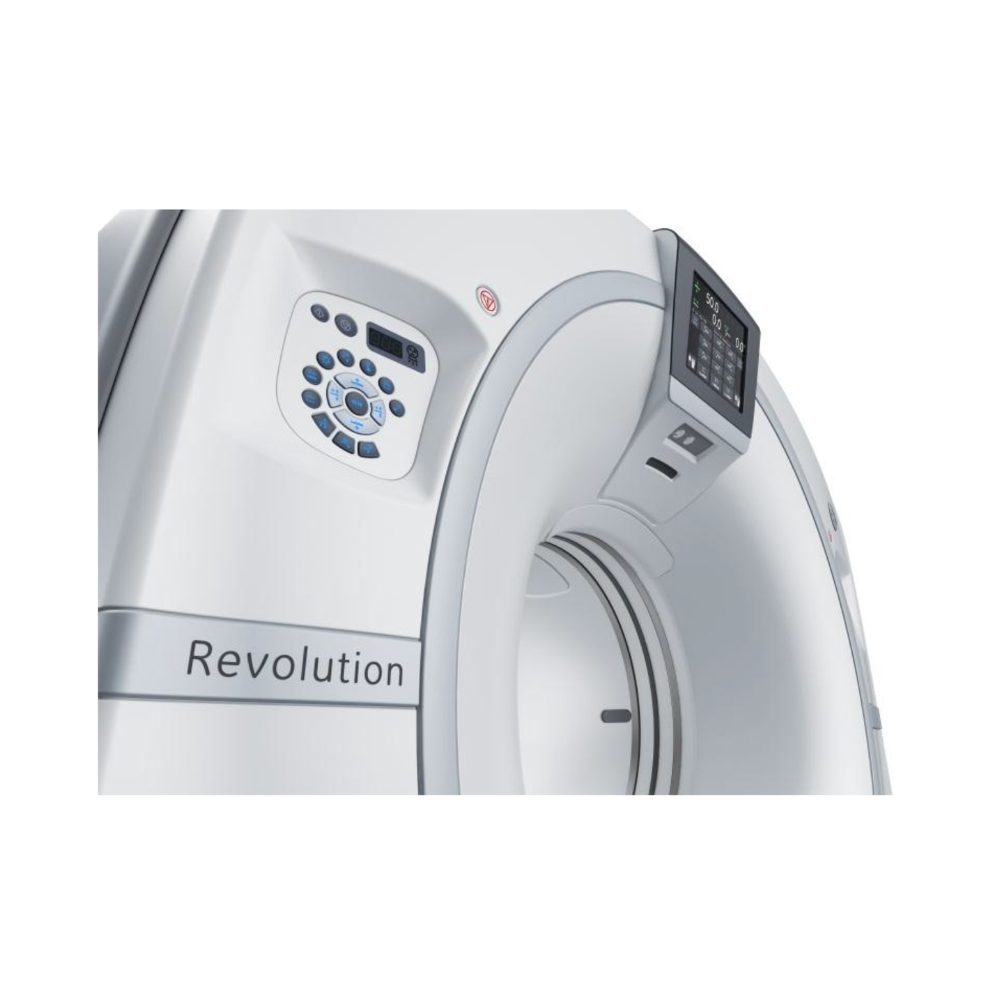
- Xtream Display & One Stop Scanning: Provide selected patient, protocol, and examination controls at the gantry to reduce repetitive setup tasks.
Compatible console upgrades can provide reconstruction speeds of up to 50 images per second. This describes image-processing throughput rather than physical scanning speed.
Contrast Timing & Clinical Connectivity
Available technologies support contrast-enhanced scanning and integration with clinical imaging systems.
-
- SmartPrep: Monitors contrast enhancement in a selected region to help determine when scanning should begin.
- Dynamic Transition: Coordinates subsequent acquisition steps during compatible contrast-enhanced examinations.
- DICOM Connectivity: Enables standardized image exchange with compatible picture archiving and communication systems (PACS) and radiology information systems (RIS).
The installed console, network configuration, and clinical software determine available automation and connectivity functions.
Clinical Environments & Applications
The GE Revolution EVO 128-slice CT scanner supports routine diagnostic imaging and specialized examinations requiring detailed reconstruction, vascular analysis, and advanced image review. Its configurable capabilities are well suited to healthcare organizations with varied clinical workloads.
Clinical Environments
-
- Hospitals and health systems
- Outpatient diagnostic imaging centers
- Cardiac and vascular imaging departments
- Emergency and trauma facilities
- Neurology and neurosurgery departments
- Oncology and cancer care centers
- Multispecialty medical practices
- Orthopedic and surgical centers
- Academic medical centers and teaching hospitals
Clinical Specialties
-
- Radiology: Routine head-to-body CT and detailed multiplanar reconstruction.
- Cardiology: Coronary CT angiography, calcium scoring, and selected cardiac assessments on equipped systems.
- Vascular Medicine: CT angiography and detailed vessel evaluation.
- Neurology & Neurosurgery: Brain and spine imaging, vascular assessment, and optional perfusion examinations.
- Orthopedics: Complex fracture evaluation, joint imaging, and postoperative assessment.
- Oncology: Tumor evaluation, disease staging, and treatment follow-up.
- Pulmonology: High-resolution chest imaging and pulmonary assessment.
- Urology: Renal stone and urinary tract imaging.
- Emergency Medicine: Acute diagnostic and trauma imaging.
Common CT Applications
-
- Routine head, chest, abdominal, and pelvic examinations
- Thin-slice and multiplanar anatomical reconstruction
- CT angiography and vascular assessment
- Coronary CT angiography on equipped systems
- High-resolution lung and musculoskeletal imaging
- Complex fracture and surgical-planning evaluation
- Imaging around metallic implants with optional Smart MAR
- Neurological perfusion on equipped systems
- Oncology staging and treatment follow-up
- Emergency and trauma CT
Revolution EVO 128 Configurations & Installed Options
Pre-owned GE Revolution EVO 128 scanners may vary by model year, reconstruction capability, console generation, X-ray tube condition, generator, patient table, and installed clinical software. These differences influence examination performance, advanced imaging capabilities, and long-term equipment planning.
128-Slice Reconstruction & Console Configuration
A Revolution EVO 128 configuration supports up to 128 overlapping reconstructed image sections in compatible acquisition modes.
Available console and imaging upgrades can provide additional capabilities, including:
-
- 128-slice overlapping reconstruction
- Updated reconstruction console hardware
- Faster image-processing throughput
- ASiR or ASiR-V reconstruction
- TrueFidelity on eligible upgraded configurations
- Smart MAR and other image-processing options
- Advanced cardiac, vascular, and neurological applications
MXR Imaging helps facilities identify available systems with the reconstruction performance and clinical applications suited to their imaging requirements.
Generator, X-Ray Tube, & Patient Table
Documented Revolution EVO generator configurations include 48 kW and 72 kW options. Generator selection influences available X-ray output and supported scanning protocols.
The platform uses the GE Performix 40 Plus X-ray tube in documented configurations, with a maximum anode heat-storage capacity of 7.0 MHU and maximum tube-assembly heat-storage capacity of 10.8 MHU. Tube installation history, usage, replacement components, and service condition vary between pre-owned systems.
Patient-table selection also affects weight capacity, scanning coverage, and positioning accessories. MXR Imaging helps facilities evaluate these hardware differences as part of equipment selection.
Clinical Software & Workstation Options
Cardiac imaging, neurological perfusion, vessel analysis, artifact reduction, and advanced post-processing applications require compatible software and licensing.
The installed console and workstation determine available clinical applications, reconstruction performance, storage capacity, and imaging network connectivity.
MXR Imaging works with facilities to identify equipment configurations suited to their clinical workload, operational requirements, and planned applications.
Revolution EVO 128 vs. Revolution EVO 64
The GE Revolution EVO 128 and Revolution EVO 64 are separate slice-count product listings within the same CT platform. Both share GE’s Clarity Imaging Chain and can use 64-channel acquisition hardware.
- GE Revolution EVO 128-Slice CT: Emphasizes up to 128 overlapping reconstructed image sections during compatible acquisition modes, supporting detailed anatomical review and multiplanar reconstruction.
- GE Revolution EVO 64-Slice CT: Emphasizes the platform’s 64-slice acquisition architecture for routine and specialty CT imaging. Compatible EVO 64 systems may also support overlapping reconstruction when equipped with the relevant option.
The 128-slice designation does not necessarily indicate a larger detector, faster rotation, or greater physical scanning coverage. Installed reconstruction software, console hardware, and clinical applications determine the practical differences between systems.
MXR Imaging helps facilities compare available configurations according to clinical requirements and examination volume.
Revolution EVO vs. Revolution HD & Apex
The GE Revolution EVO, Revolution HD, and Revolution Apex use different detector and reconstruction technologies. These distinctions help facilities evaluate which imaging platform best fits their diagnostic and operational needs.
- Revolution EVO: Uses the Clarity Imaging Chain with configurable reconstruction and workflow technology for routine and specialized cardiac, vascular, and neurological examinations.
- Revolution HD: Uses a high-resolution Gemstone detector and Volara data acquisition technology, with spatial resolution as fine as 0.23 mm (0.009 in). Compatible systems also support Gemstone Spectral Imaging for additional tissue and material characterization. Compare the GE Revolution HD 64-Slice CT and GE Revolution HD 128-Slice CT.
- Revolution Apex: Offers a range of detector configurations with different anatomical coverage and advanced imaging options. Compatible systems support rapid acquisition, deep-learning reconstruction, and demanding cardiac and vascular workflows. Compare the GE Revolution Apex 256-Slice CT and GE Revolution Apex Elite 512-Slice CT.
Differences between platforms depend on the installed hardware and software, not simply their model names. MXR Imaging helps facilities compare detector coverage, clinical capabilities, workflow requirements, and available equipment configurations.
Revolution EVO 128 Installation & Site Requirements
The Revolution EVO requires an appropriately prepared CT imaging suite with electrical service, cooling, ventilation, radiation shielding, and structural support.
Site planning includes the gantry, patient table, operator console, supporting equipment, patient access, and maintenance clearances. Infrastructure requirements depend on the generator configuration, installed components, and room layout.
MXR Imaging’s turnkey imaging project management services help coordinate equipment selection, site preparation, installation, and related requirements.
Revolution EVO 128 CT Price & Availability
MXR Imaging offers pre-owned GE Revolution EVO 128-slice CT scanners for hospitals, imaging centers, and specialty practices seeking detailed anatomical reconstruction and configurable advanced imaging capabilities.
Pricing depends on equipment condition, X-ray tube history, generator configuration, reconstruction hardware, clinical software licenses, patient table, accessories, installation, and service requirements. Console upgrades and specialty applications can also influence the overall project cost.
Eligible systems may be available through MXR Imaging’s Platinum Certified program, providing an additional inspection and reconditioning pathway. CT maintenance and repair services are also available to support ongoing equipment performance.
Request a quote for the GE Revolution EVO 128 to discuss available configurations, clinical capabilities, installation requirements, and ongoing support.
GE Revolution EVO 128-Slice CT Specifications
The following specifications reflect Revolution EVO platform capabilities and supported 128-slice configurations. Installed hardware, software, patient tables, and clinical options may vary between systems.
CT Acquisition & Reconstruction
-
- Manufacturer: GE Healthcare
- Model: Revolution EVO
- Slice configuration: 128-slice CT
- Acquisition architecture: 64 detector channels
- Maximum overlapping reconstruction: Up to 128 image sections per rotation in compatible axial modes
- Detector technology: GE Clarity
- Detector configuration: 64 × 0.625 mm
- Detector coverage: 40 mm (1.57 in)
- Minimum acquired slice thickness: 0.625 mm (0.025 in)
- Spatial resolution: As fine as 0.28 mm (0.011 in)
- Minimum gantry rotation: 0.35 seconds on compatible configurations
- Maximum helical pitch: Up to 1.531 on supported configurations
- Scanning modes: Axial, helical, cine, and compatible advanced protocols
Gantry & Patient Table
-
- Gantry opening: 70 cm (27.6 in)
- Gantry tilt: ±30°
- Maximum scan field of view: 50 cm (19.7 in)
- Table options: VT1700V, VT2000, and VT2000x
- Standard patient capacity: Up to 500 lb (227 kg)
- Higher-capacity table: Up to 675 lb (306 kg) with VT2000x
- Maximum axial scannable range: Up to 173 cm (68.1 in) or 200 cm (78.7 in), depending on table
- Patient positioning: Motorized table
X-Ray Generator & Tube
-
- Generator options: 48 kW or 72 kW
- Documented X-ray tube: GE Performix 40 Plus
- Tube voltage: 80, 100, 120, and 140 kVp
- Tube-current range: Generator- and protocol-dependent
- Maximum anode heat capacity: 7.0 MHU
- Maximum tube-assembly heat capacity: 10.8 MHU
- Tube cooling: Dependent on installed hardware
- Installed tube history: Varies by system
Reconstruction & Imaging Technology
-
- Imaging platform: GE Clarity Imaging Chain
- Overlapping reconstruction: Up to 128 image sections per rotation in compatible axial modes
- Iterative reconstruction: ASiR or ASiR-V, configuration-dependent
- Deep-learning reconstruction: TrueFidelity on eligible later-generation or upgraded configurations
- Metal artifact reduction: Smart MAR, optional
- Additional artifact reduction: AAR and IQ Enhance, configuration-dependent
- Multiplanar reconstruction: Direct MPR where installed
- 3D visualization: Available with compatible clinical software
- Upgraded reconstruction throughput: Up to 50 images per second on compatible configurations
Advanced Imaging & Dose Management
-
- Cardiac CT: Available ECG-synchronized acquisition
- Cardiac motion correction: SnapShot Freeze where installed
- Calcium scoring: SmartScore Pro where installed
- Vascular imaging: Compatible CT angiography and vessel analysis
- Perfusion imaging: Configuration-dependent
- Automated exposure control: AutomA and SmartmA
- Organ dose modulation: Available
- Dose monitoring: Dose Check and reporting, configuration-dependent
Connectivity & Site Requirements
-
- Image data standard: DICOM
- Clinical connectivity: Compatible PACS and RIS integration
- Electrical service: Dependent on generator and installed configuration
- Radiation shielding: Based on facility and regulatory requirements
- Cooling and ventilation: Based on installed equipment
- Room dimensions: Installation-dependent
- Structural support: Required for gantry and patient table
- Service clearances: Configuration-dependent