AMRAD Medical by Summit Odyssey Mobile X-Ray
- Category:
- X-Ray Systems
- Brand:
- AMRAD Medical by Summit
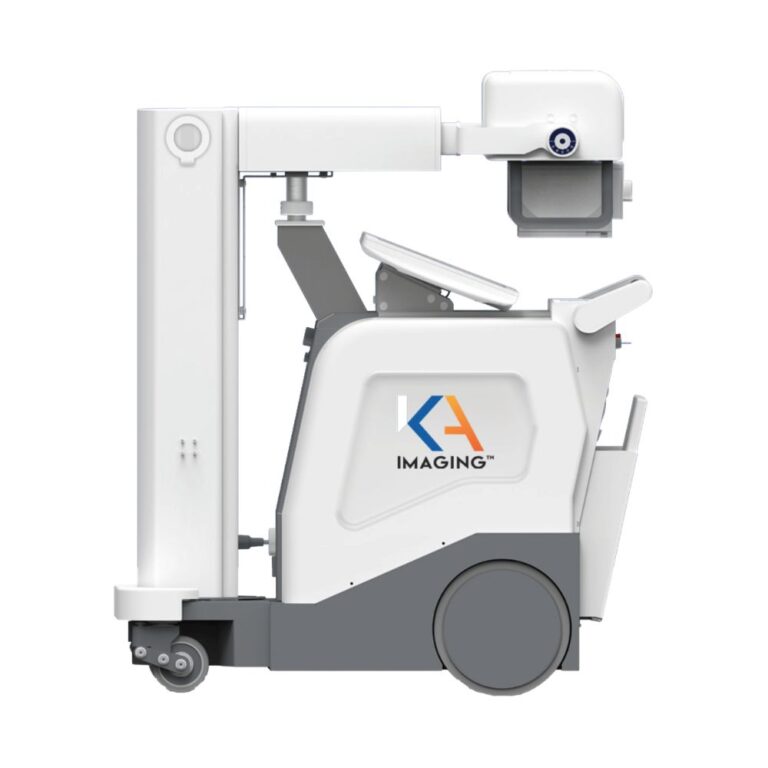
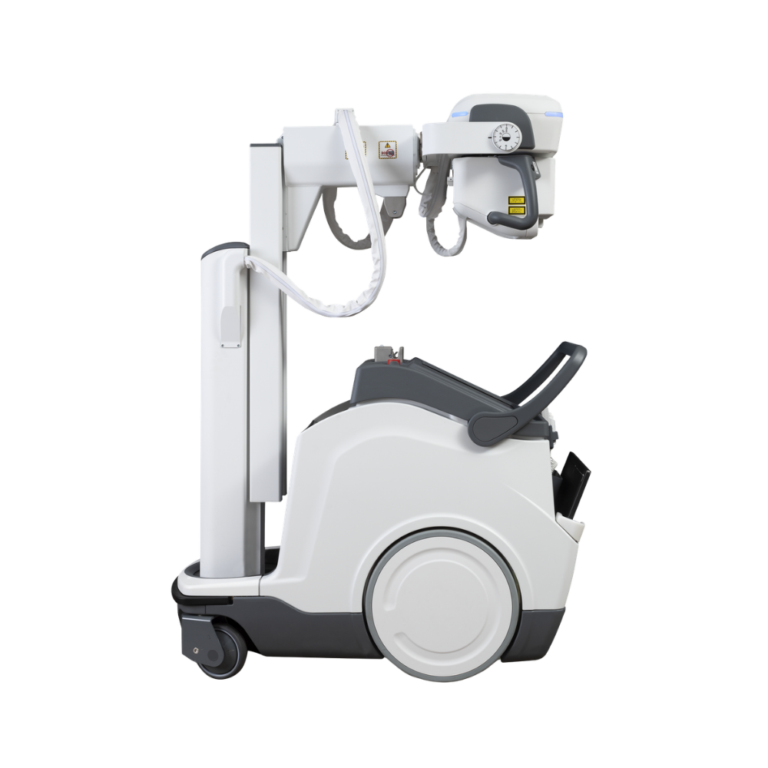
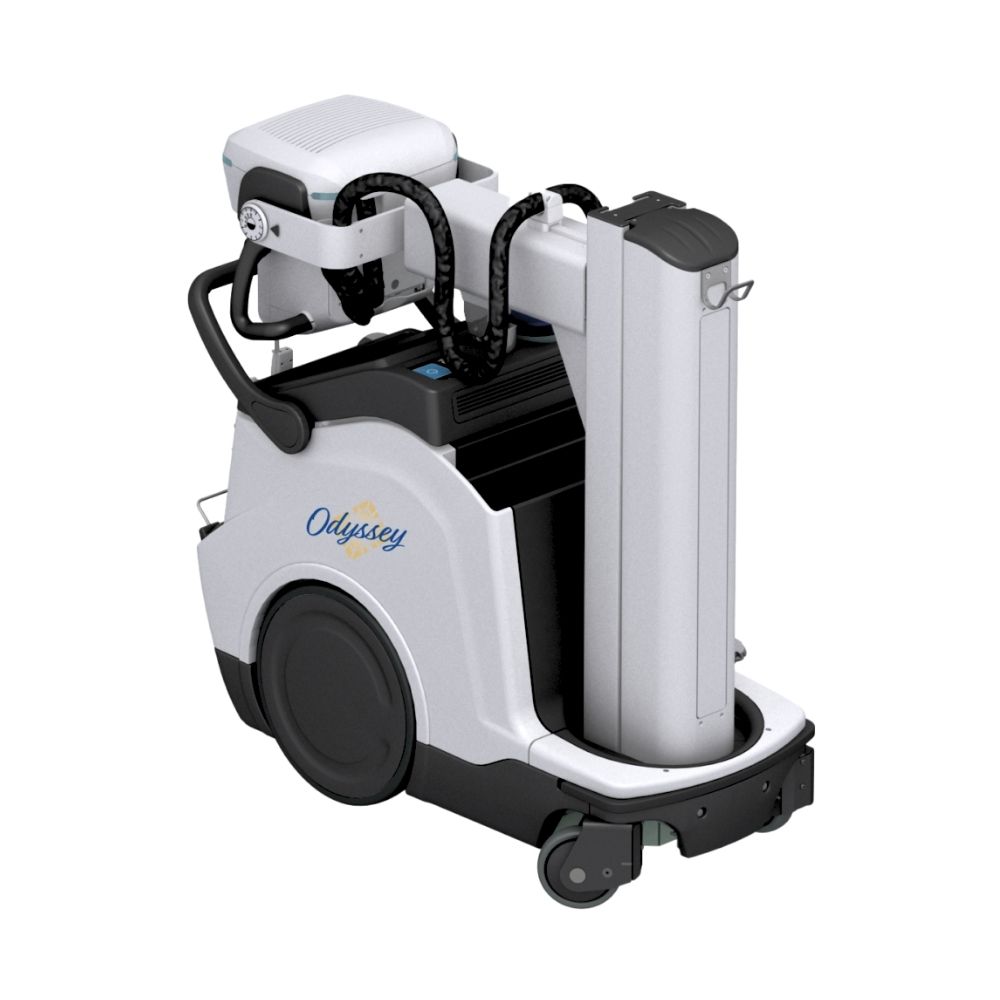
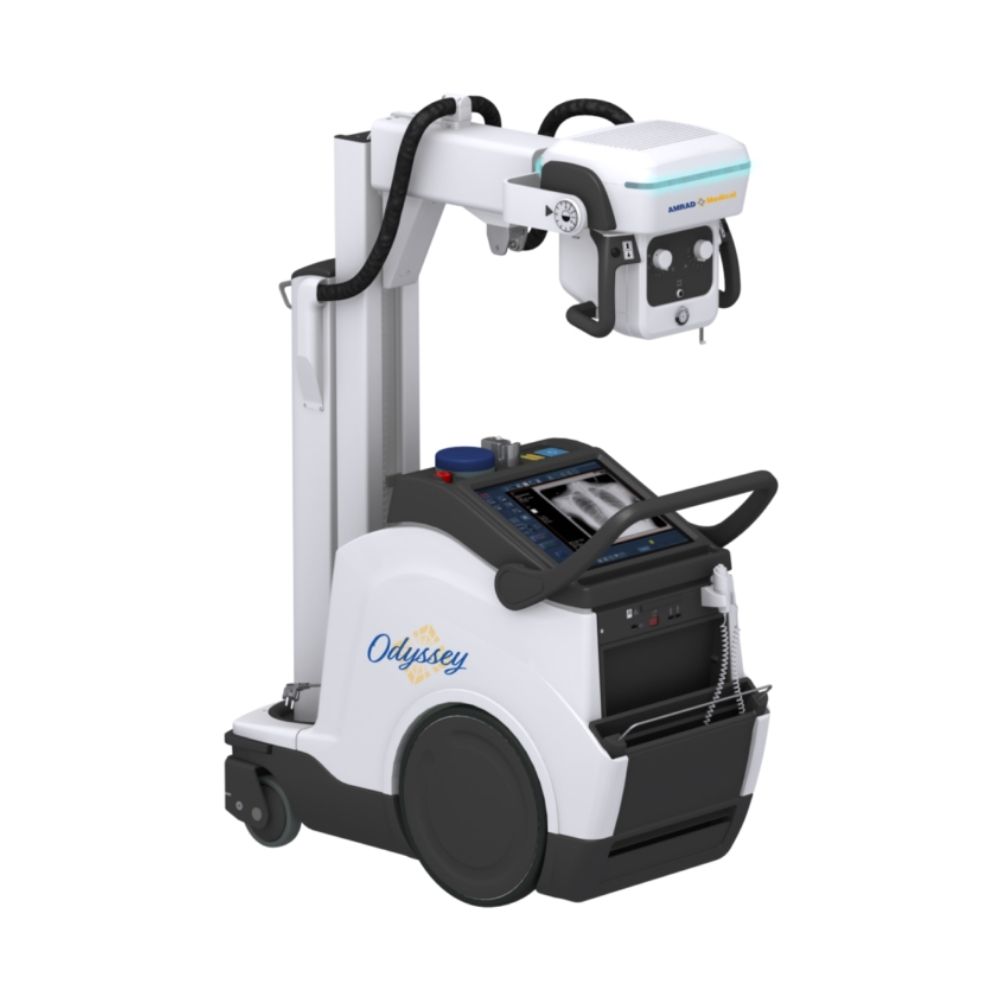
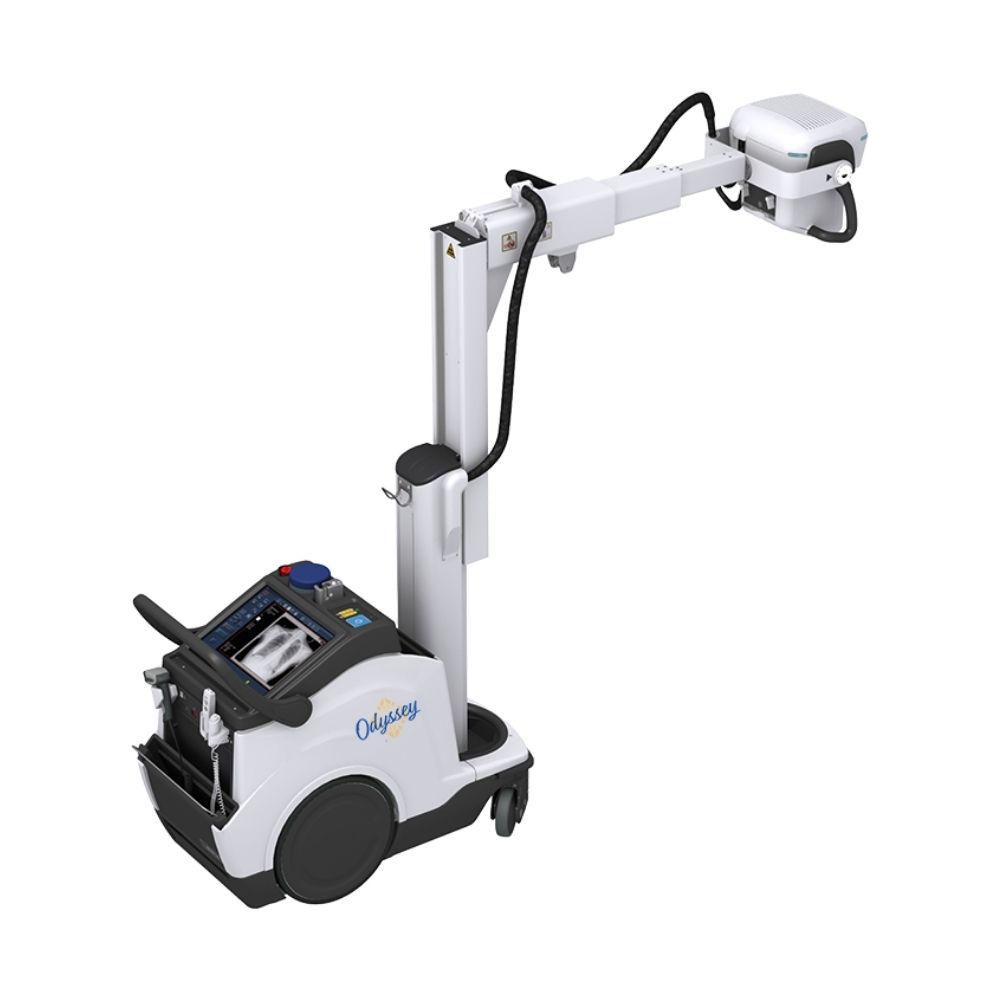
The AMRAD Medical Odyssey is a 32 kW mobile digital X-ray system for healthcare facilities that need flexible point-of-care and bedside radiography. Its compact, motor-assisted design combines a three-step telescopic arm, 19-inch touchscreen, and integrated Canon CXDI-Pro wireless DR for efficient positioning and image acquisition.
AMRAD Medical Odyssey Highlights & Benefits
The AMRAD Medical Odyssey combines a 32 kW high-frequency generator, motor-assisted movement, flexible tube positioning, and integrated Canon wireless DR in a compact mobile radiography system. Part of the AMRAD Medical by Summit product line, the Odyssey is designed to bring digital imaging directly to patients while supporting efficient movement and positioning throughout clinical environments.
Odyssey Key Benefits
-
- 32 kW high-frequency generator with a 40 to 150 kVp range
- Three-step telescopic arm extending from 27.7 to 48 in. (70.5 to 122 cm)
- Motor-assisted Easy Moving System for maneuverability
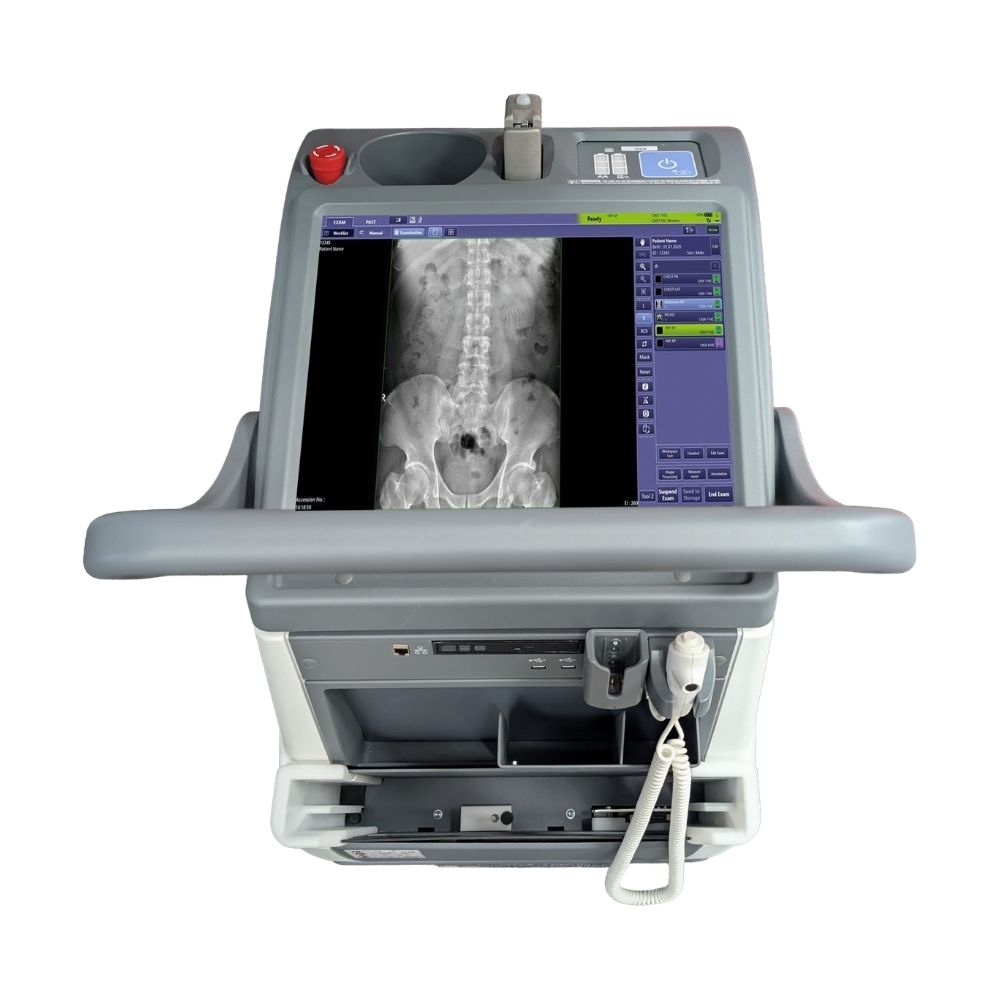
- 19 in. (48.3 cm) integrated color touchscreen for image preview and controls
- Canon CXDI-Pro wireless DR detector options
- Energy Recovery Technology and Optimized Battery Management
- More than 800 exposures under specified operating conditions
- Retractable telescopic column for transport visibility and compact storage
When fully compacted, the Odyssey measures 50.7 in. H x 50 in. W x 21.3 in. D (129 x 127 x 54 cm). Its compact profile, powered drive, and retractable column help support movement through patient-care areas where maneuvering space may be limited.
Odyssey Bedside X-Ray Workflow
The Odyssey is designed around the movement and positioning demands of mobile radiography. Motor-assisted transport, a three-step telescopic arm, integrated image review, and onboard exposure controls help technologists bring the system to the patient and manage digital X-ray exams from the mobile unit.
Easy Moving System for Motor-Assisted Transport
The patented Easy Moving System uses motor-assisted drive and capacitive-touch handle controls to support one-handed movement. The system can travel forward at up to approximately 3.4 mph (5.5 km/h).
At low speed, each wheel can also be moved independently to help fine-tune the Odyssey’s position around patient beds, wheelchairs, and other obstacles.
Three-Step Telescopic Arm & Tube Positioning
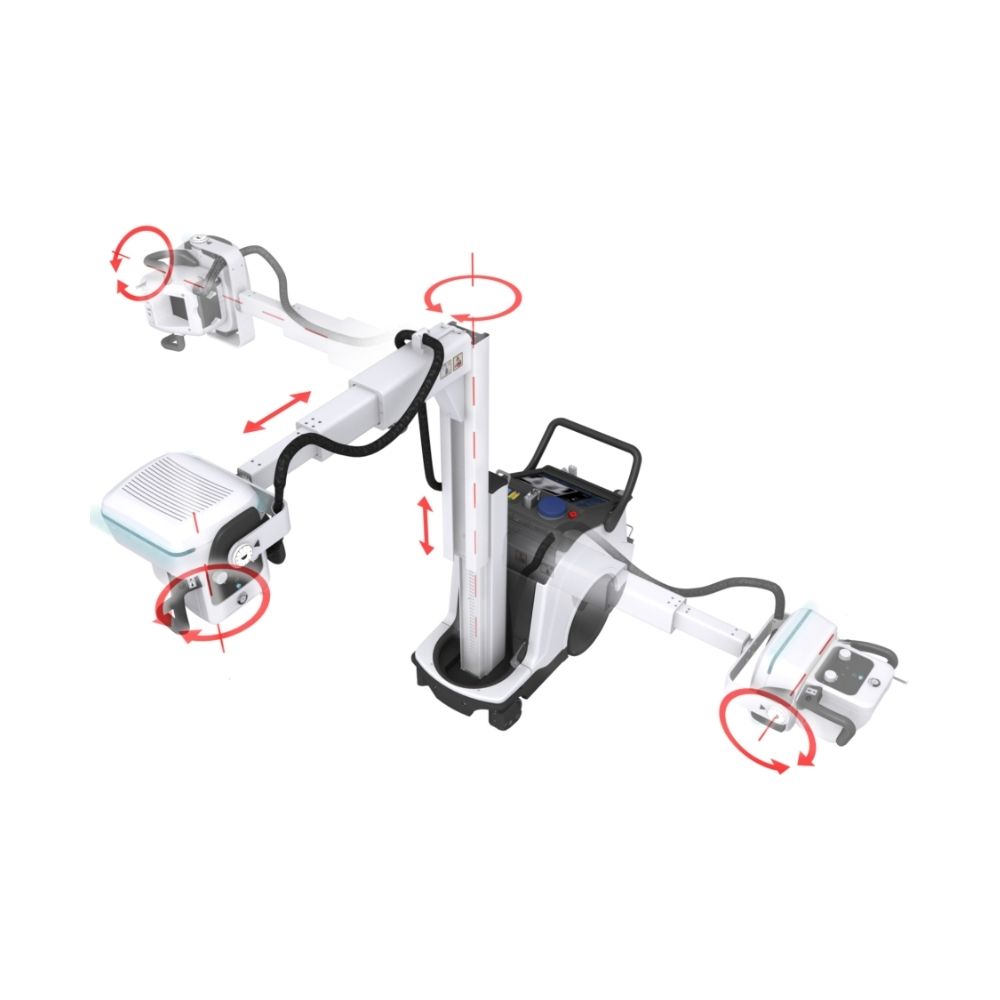
The Odyssey uses a three-step telescopic arm that extends from 27.7 to 48 in. (70.5 to 122 cm). The telescopic column provides a maximum SID of 79.5 in. (202 cm) and a minimum focal distance from the floor of less than 20.8 in. (53 cm).
Additional positioning capabilities include:
-
- Column rotation of ±317°
- Collimator rotation of ±90° with a 0° detent
- Head rotation perpendicular to the arm from -30° to +90°
- Head rotation around the arm axis of ±180°
- Optional electromagnetic brakes for multidirectional tube-head movement
These positioning ranges give technologists multiple ways to align the X-ray source around the patient without relying only on movement of the entire unit.
19-Inch Touchscreen, Handswitch & Exposure Controls
The integrated 19 in. (48.3 cm) color touchscreen allows the operator to preview acquired images and access image-enhancement tools directly from the Odyssey console.
A two-step PREP and EXPOSE handswitch supports X-ray operation, while a collimator lamp button assists with patient positioning. Keeping image review and exposure controls on the mobile system supports a more direct workflow at the point of care.
Odyssey Retractable Column, Transport Visibility & Safety
The fully counterbalanced telescopic column retracts to a height of 50.7 in. (129 cm), lowering the Odyssey’s profile to provide a clearer forward view during transport and more compact storage when the system is not in use.
An Emergency OFF switch allows the unit to be transferred to manual movement when needed. Anti-collision proximity sensors are also available as an option.
AMRAD Medical Odyssey vs. Odyssey Plus Mobile X-Ray
The AMRAD Medical Odyssey uses a 32 kW high-frequency generator and three-step telescopic arm, while the Odyssey Plus increases generator output to 40 kW and uses a four-step telescopic arm.
The Odyssey arm retracts to 27.7 in. (70.5 cm), compared with 24.8 in. (63 cm) on the Odyssey Plus. Both extend to 48 in. (122 cm).
The two systems also differ in their control configurations. The standard Odyssey uses an integrated 19 in. (48.3 cm) console touchscreen, while the Odyssey Plus adds a secondary 8.4 in. (21.3 cm) touchscreen at the tube head. Electromagnetic brakes for multidirectional tube-head movement are optional on the Odyssey and standard on the Odyssey Plus.
Their compacted dimensions also differ slightly. The Odyssey measures 50 in. (127 cm) wide, while the Odyssey Plus measures 48 in. (122 cm) wide.
For facilities comparing the two systems, generator output, arm retraction, bedside controls, tube-head braking, and compacted dimensions are important configuration differences to evaluate.
View the AMRAD Medical Odyssey Plus mobile X-ray system for features and specifications for the 40 kW configuration.
Where the AMRAD Medical Odyssey Fits into Mobile Radiography
The Odyssey is designed for general radiography in clinical environments where imaging needs to be brought to the patient rather than performed exclusively in a fixed X-ray room.
Clinical Environments Suited to the Odyssey
The Odyssey can support mobile radiography workflows in:
-
- Hospitals and health systems
- Medical imaging facilities and departments
- Inpatient and bedside care areas
- Emergency care environments
- High-dependency patient care environments
- Other healthcare facilities where mobile general radiography is required
Its motor-assisted movement, compact design, flexible tube positioning, and wireless detector options are particularly relevant when patient transport or access around the patient presents workflow challenges.
General Radiography Applications for the Odyssey
The Canon CXDI-Pro detectors available with the Odyssey are designed for general radiography. The system supports digital X-ray workflows that require mobile equipment positioning, flexible patient access, and wireless image acquisition.
Canon image-processing capabilities also include enhancement settings intended to improve visualization of small structures, bone detail, tubes, and catheters.
Canon CXDI-Pro Wireless DR Integration for the Odyssey
The Odyssey with Canon DR can be fully integrated with Canon CXDI-Pro wireless digital radiography detectors and Canon CXDI Control Software NE.
This configuration combines the Odyssey’s mobile X-ray generator and positioning platform with wireless image acquisition, image review, and processing.
Canon CXDI-Pro Detector Size Options
Three Canon wireless detector formats are available:
-
- CXDI-803C: 11 x 14 in. (273 x 349 mm)
- CXDI-703C: 14 x 17 in. (349 x 426 mm)
- CXDI-403C: 17 x 17 in. (426 x 426 mm)
The available sizes allow facilities to select an Odyssey detector configuration based on imaging-area requirements, positioning needs, and preferred detector handling.
Choosing a Canon CXDI-Pro Detector for the Odyssey
The CXDI-803C provides the smallest imaging area and is the lightest option at 4.6 lb. (2.1 kg) with battery. The CXDI-703C provides a 14 x 17 in. (349 x 426 mm) imaging area at 6.4 lb. (2.9 kg), while the CXDI-403C provides a 17 x 17 in. (426 x 426 mm) imaging area at 7.7 lb. (3.5 kg).
This allows facilities to configure the Odyssey around the imaging area and detector-handling characteristics that best fit their mobile radiography workflow.
CXDI-Pro Wireless Detector Performance & Protection on the Odyssey
The CXDI-Pro detectors use amorphous silicon flat-panel technology with cesium iodide scintillators. Automatic Exposure Detection allows the detector to internally recognize an X-ray exposure without requiring a direct physical exposure signal from the system.
The detectors also provide IP55 protection against limited dust ingress and low-pressure water jets for added assurance during use and cleaning in demanding clinical environments.
The CXDI-703C and CXDI-403C incorporate an ergonomic handgrip and rounded detector corners to support handling and patient positioning.
Canon CXDI Control Software Integration for the Odyssey
Canon CXDI Control Software NE provides the acquisition and image-processing platform for the Odyssey’s integrated CXDI wireless detectors.
Odyssey DICOM, Worklist & Dose Reporting with CXDI Control Software
CXDI Control Software NE supports:
-
- Windows 11
- Interactive graphical user interface
- Image rotation
- IHE compliance
- User and connection authentication
- Flexible DICOM configuration for worklists and image export
- IHE ATNA support for secure DICOM and audit trails
- Radiation Dose Structured Report
- MPPS
- Exposure logs
These capabilities support worklist-driven acquisition, DICOM image transfer, user authentication, and dose-reporting workflows within the Odyssey’s Canon DR configuration.
Odyssey Image Processing with Edge Enhancement & Scatter Correction
Advanced Edge Enhancement provides image-processing settings for small structures, bone detail, and catheter visualization.
Optional Scatter Correction is designed to support imaging without a physical grid while helping maintain image contrast, reduce detector handling weight, and avoid grid misalignment and related artifacts.
Odyssey Battery Runtime, Energy Recovery & 32 kW Generator
The Odyssey combines battery-powered mobility with a 32 kW constant-potential high-frequency generator. Energy Recovery Technology, onboard battery capacity, and charging capability are designed to keep the system available for both powered movement and X-ray exposure between patient locations.
Odyssey Energy Recovery, Battery Runtime & Charging
Energy Recovery Technology uses braking energy to help recharge the onboard batteries during operation.
Optimized Battery Management provides:
-
- 15 Ah charge capacity per battery
- 5,760 Wh total energy storage capacity
- More than 800 exposures at the stated test technique of 80 kV, 400 mA, and 5 ms
- More than 11 hours of standby time with the system ready to work
- More than 15.5 miles (25 km) of travel at approximately 3.4 mph (5.5 km/h)
- Up to approximately 0.62 mile (1 km) of additional movement after exposure capacity is exhausted
- Approximately 80% charge after four hours
- Full charge in approximately eight hours
X-ray exposures can also be performed while the Odyssey is connected to a power source.
Dual-Battery Charging for Odyssey Canon Detectors
The detector battery charger can charge up to two Canon detector batteries at the same time. Indicator lights show charging status at 25%, 50%, 75%, and 100%, and charging stops automatically when full battery capacity is reached.
This allows additional detector batteries to be charged while the Odyssey remains available for mobile imaging workflow.
Odyssey 32 kW Constant-Potential Generator
The Odyssey uses a single-phase, high-frequency 32 kW generator with output from 40 to 150 kVp and up to 500 mA.
Its constant-potential design uses closed-loop control of X-ray tube current, kVp, and filaments. Monoblock construction eliminates external high-voltage cables, while multiple microprocessors regulate generator operation for exposure consistency and system efficiency.
Choosing the AMRAD Medical Odyssey for Mobile Radiography
The AMRAD Medical Odyssey is designed for healthcare facilities evaluating a 32 kW motor-assisted mobile X-ray system with a three-step telescopic arm, onboard image review, and configurable Canon wireless DR.
Its Canon CXDI-Pro detector options allow the digital configuration to be matched to imaging-area and detector-handling requirements, while optional tube-head brakes and anti-collision sensors provide additional configuration flexibility.
Contact MXR to discuss Odyssey configurations, Canon detector options, system requirements, and how the system can fit into your mobile radiography workflow.
AMRAD Medical Odyssey Specifications
Odyssey System & Transport
-
- System type: Mobile digital radiography system
- Generator output: 32 kW
- Compacted dimensions: 50.7 in. H x 50 in. W x 21.3 in. D (129 x 127 x 54 cm)
- Maximum forward speed: Approximately 3.4 mph (5.5 km/h)
- Integrated touchscreen: 19 in. (48.3 cm)
- Drive system: Motor-assisted Easy Moving System
- Independent low-speed wheel movement
- Optional anti-collision proximity sensors
- Optional electromagnetic tube-head brakes
Odyssey Three-Step Telescopic Arm & Tube Positioning
-
- Three-step telescopic arm
- Arm extension: 27.7 to 48 in. (70.5 to 122 cm)
- Maximum SID: 79.5 in. (202 cm)
- Minimum focal distance from floor: Less than 20.8 in. (53 cm)
- Column rotation: ±317°
- Collimator rotation: ±90° with 0° detent
- Head rotation perpendicular to arm: -30° to +90°
- Head rotation around arm axis: ±180°
- Head rotation detents: -90°, 0°, +90°
Odyssey 32 kW Generator
-
- Generator type: Single-phase, high-frequency constant-potential generator
- kVp range: 40 to 150 kVp in 1 kVp increments
- mA range: 10 to 500 mA in 18 steps
- mAs range: 0.1 to 500 mAs in 38 steps
- Minimum power: 0.4 kW at 40 kVp / 10 mA
- Maximum power: 32 kW
- Closed-loop control of X-ray tube current, kVp, and filaments
- Monoblock design without external high-voltage cables
Odyssey Battery & Charging
-
- Charge capacity per battery: 15 Ah
- Total energy storage capacity: 5,760 Wh
- Exposure autonomy: More than 800 exposures at 80 kV, 400 mA, and 5 ms under stated conditions
- Standby autonomy: More than 11 hours
- Travel autonomy: More than 15.5 miles (25 km) at approximately 3.4 mph (5.5 km/h)
- Approximate charge level after four hours: 80%
- Approximate full charge time: Eight hours
- X-ray exposure capability while connected to external power
Canon CXDI-Pro Wireless DR Options
-
- CXDI-803C: 11 x 14 in. (273 x 349 mm) imaging area; 4.6 lb. (2.1 kg) with battery
- CXDI-703C: 14 x 17 in. (349 x 426 mm) imaging area; 6.4 lb. (2.9 kg) with battery
- CXDI-403C: 17 x 17 in. (426 x 426 mm) imaging area; 7.7 lb. (3.5 kg) with battery
- Detector technology: Amorphous silicon flat-panel detector with cesium iodide scintillator
- Pixel size: 140 μm
- Grayscale: 16-bit A/D
- Limiting resolution: 3.5 lp/mm
- Protection rating: IP55
- Wireless standard: IEEE 802.11ac
- Wireless bands: 2.4 GHz and 5 GHz
- Automatic Exposure Detection supported
- Ready time: Less than four seconds, depending on acquisition mode
- Preview image time: Approximately one second, depending on acquisition mode